How to weld for beginners: gear, setup and safety
How to weld for beginners: choose a first process, set up a safe space, gather PPE and read your MIG settings chart, per Miller, OSHA and ANSI Z49.1.


To learn to weld as a beginner, pick one process (MIG, or gasless flux-core if you work outdoors), get a helmet, gloves and a fire-safe ventilated corner, then practise straight beads on clean scrap using the settings chart of your machine. Miller Electric calls MIG the easiest process to learn, and its starting rules (1 amp per 0.001 inch of steel, a 3/8 inch wire stickout, 20 cfh of gas) get you to a usable bead quickly. Here is the whole path, step by step, with the machines that suit a first buy.
Our rankings for this: best TIG welders for beginners, best flux core welders and best multiprocess welders.
Affiliate disclosureAs an Amazon Associate we earn from qualifying purchases made through links on this page. Commissions never change our ratings.
Pick a first process and a first machine
Start with MIG if you weld indoors on clean steel: the wire feeds itself, there is no slag, and Miller says it gives better control on thin metal. Start with flux-core if you weld outside or on rusty steel and do not want a gas bottle; it is more forgiving on dirty metal but leaves slag. Stick comes next for heavier repair work, and TIG last, because it needs both hands and is the hardest to master.
A multiprocess welder lets you start on wire and try stick and lift TIG later on the same machine. Our multiprocess ranking and MIG vs TIG vs stick guide help with that choice.
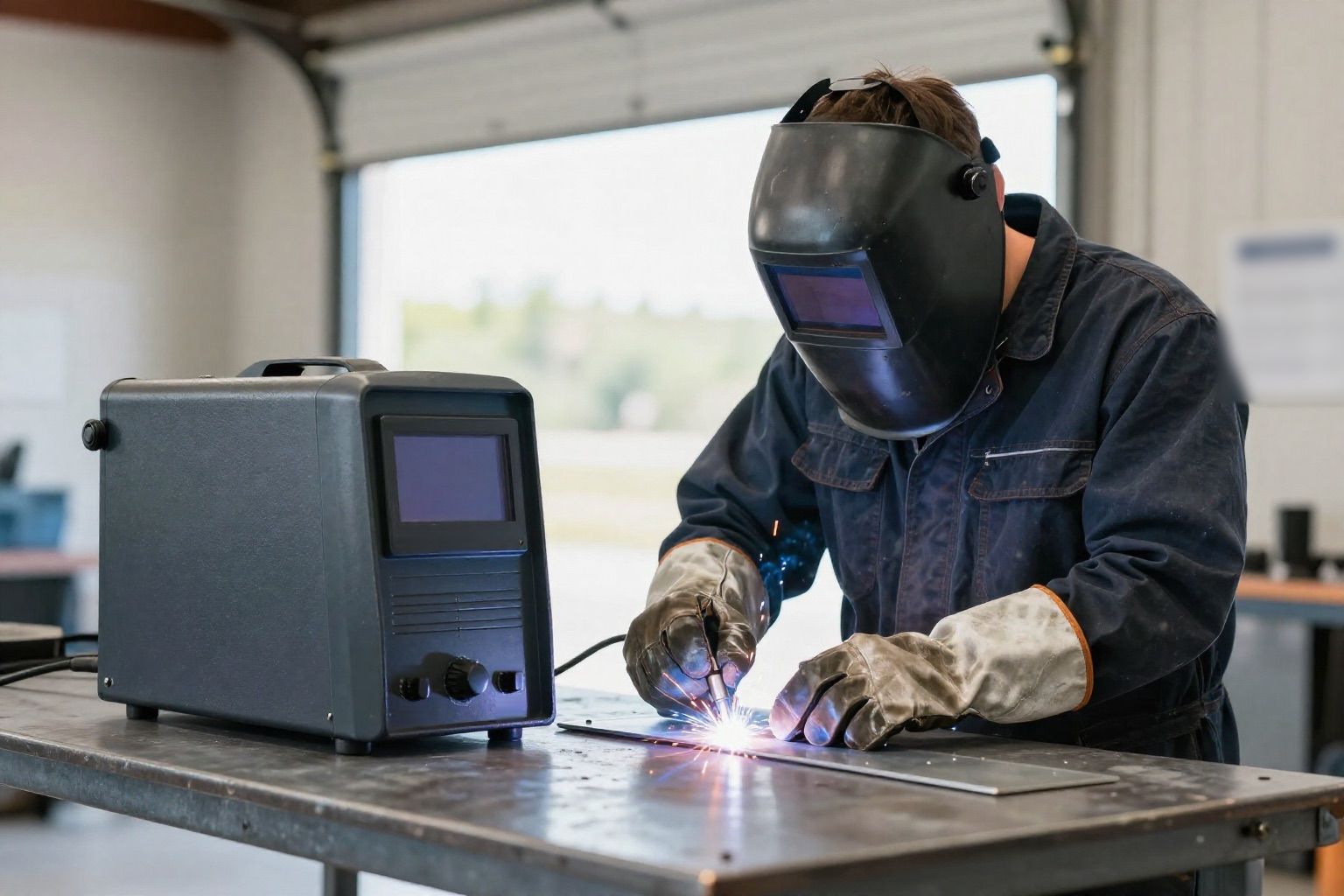
Protective gear before the first arc
- An auto-darkening helmet. OSHA suggests shade 11 for MIG at 60-160 A, 10 for stick at the same current.
- Safety glasses worn under the helmet (Miller).
- Flame-resistant welding gloves and a jacket or sleeves that cover all skin.
- Leather or steel-toed boots.
Details and the full shade table are in our welding safety guide.
Prepare a fire-safe, ventilated corner
OSHA's workplace benchmark is to move combustibles at least 35 feet away or cover them, and to keep fire extinguishing equipment ready. At home: clear the floor and bench, keep an extinguisher within reach, open the door or use extraction, and weld on a steel bench or bare concrete. OSHA ranks flux-core as the process with the most fume, so ventilate more for it. Remove paint, zinc and oil from the metal before welding.
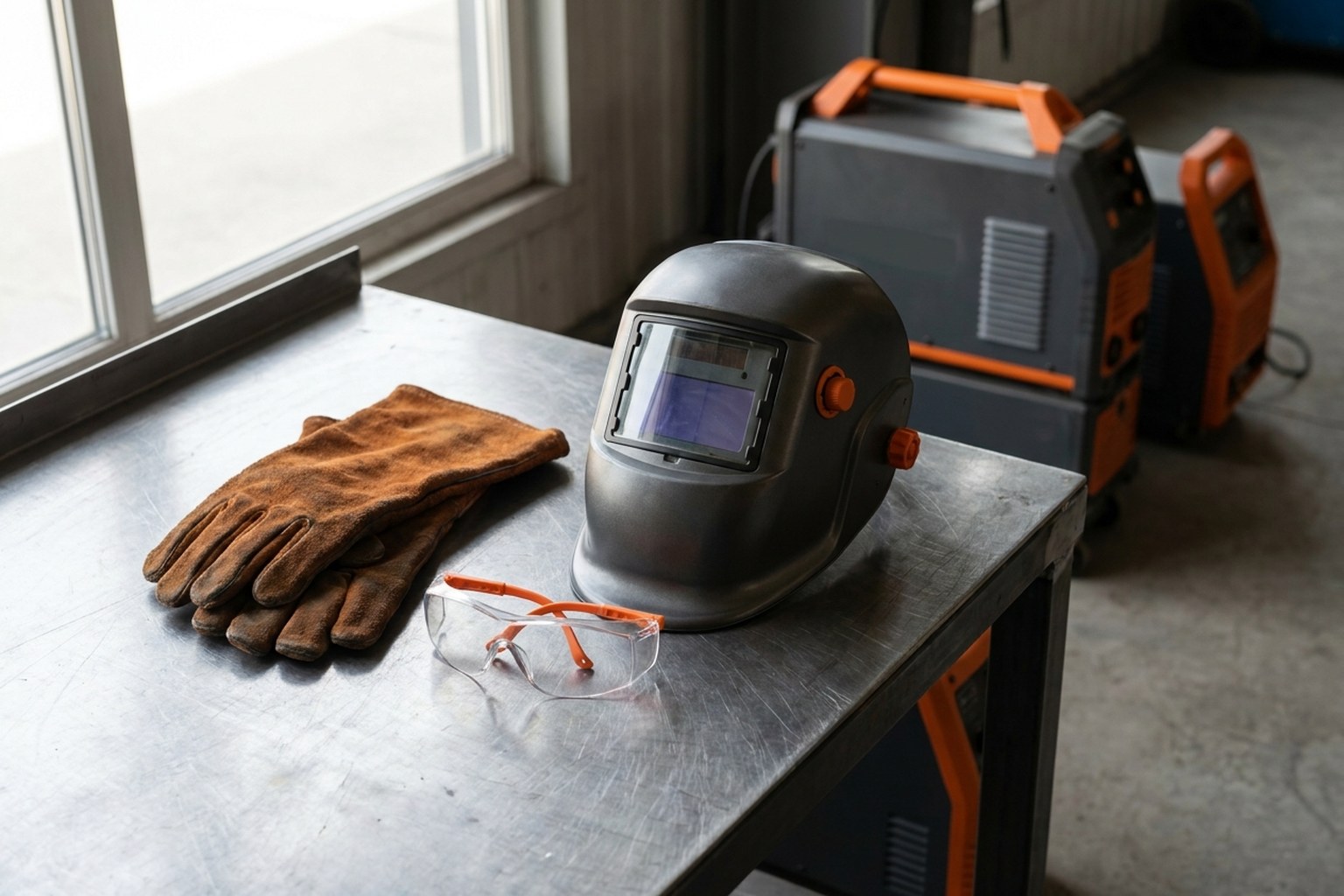
Set up a MIG welder: the four settings
Miller's MIG parameter guide boils setup down to four steps. Read your machine's manual first, then:
| Setting | Starting point |
|---|---|
| Amperage | 1 A per 0.001 in: about 125 A for 1/8 in steel |
| Wire size | 0.030 in for 40-145 A, 0.035 in for 50-180 A |
| Wire feed speed | 0.030 in wire: about 2 inches per minute per amp (250 ipm at 125 A) |
| Voltage | Tune until the arc is crisp: more if the wire stubs, less if it burns back |
| Gas flow | About 20 cfh for light work |
| Stickout | About 3/8 in |
| Gun angle | Push with a 15 degree travel angle; 90 degrees to a butt joint, 45 degrees in a fillet |
For flux-core, Miller switches two rules: the polarity is DCEN, and you drag the gun instead of pushing ("if there is slag, you drag"). Many machines have a chart inside the side panel with voltage and wire speed by thickness; Hobart prints one on its Handler 140 spec sheet. Use it first, then fine-tune.
Practise, then read the bead
Run straight beads on flat scrap of the thickness you will weld, then fillets on two pieces at 90 degrees. Miller's guide shows what the bead tells you:
- Good weld: flat bead, even width, edges that blend into the metal.
- Narrow, tall bead with poor edges: travel too fast or amperage too low.
- Very wide bead or burn-through: travel too slow or wire speed too high.
- Lots of spatter and a convex bead: voltage too low.
- Pinholes and porosity: no gas or not enough gas.
Cut or break a practice piece now and then to see whether the weld really fused into both sides. Help from an experienced welder, a class or a community college course shortens all of this; the American Welding Society, which Miller points to for learning, is a good starting point.
Which first machine from our ranking
- Household outlet, outdoor or gasless start: YESWELDER 135A 3-in-1 MIG Welder (rated 9.4/10), listed with flux-core MIG, lift TIG and stick on 110 V.
- Gas MIG for clean indoor work, room to grow: YESWELDER 160A MIG Welder (8.7/10), listed with MIG, flux-core, lift TIG and stick on 110V/220V.
- Simple MIG-only machine on 120 V: Hobart Handler 140EZ MIG Welder (7.1/10), listed at 30-140 A, flux-core and spool gun ready.
- Starting with TIG anyway: our TIG welders for beginners ranking.
Whichever you pick, check the settings chart, the drive rolls and contact tips for your wire size, and the duty cycle at the amperage you will use (see our duty cycle guide).
Our rated picks
The three best-rated models of our best multiprocess welders ranking, from the buyer review record and the listed specs.
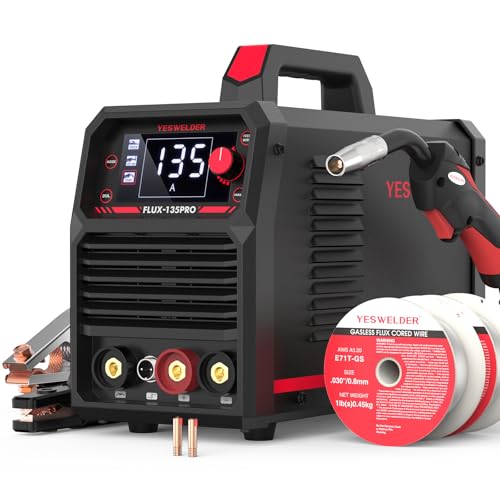


Product images: Amazon listings
Frequently asked questions
What is the easiest welding for beginners?
MIG. Miller Electric calls it the easiest process to learn: the wire feeds automatically, there is no slag, and it controls well on thin metal. Gasless flux-core is almost as easy and better outdoors.
What welder should a beginner buy?
A MIG or multiprocess welder that runs on the outlet you have and covers the thickness you weld most. On 120 V that usually means steel up to about 1/8 inch in one pass.
Can I teach myself to weld?
Many people learn the basics on their own with good safety gear, practice on scrap and the machine's settings chart. Instruction from a qualified welder or a class makes it faster and safer.
Do I need gas to start welding?
Not if you start with self-shielded flux-core wire or stick, which make their own shield. Gas MIG and TIG need a cylinder and a regulator.
Sources
- Miller Electric — Buying Your First Welder: A Practical, Informative Guide for Do-It-Yourselfers (consulted Nov 2026)
- Miller Electric — MIG Welding: Setting the Correct Parameters (consulted Nov 2026)
- Miller Electric — MIG Welding Tips and Techniques for Beginners (consulted Nov 2026)
- Miller Electric — Flux-Cored Welding: The Basics for Mild Steel (consulted Nov 2026)
- Hobart Welding Products (spec sheet, dealer-hosted PDF) — Handler 140 specification sheet (consulted Nov 2026)
- U.S. Occupational Safety and Health Administration — Eye Protection against Radiant Energy during Welding and Cutting (fact sheet, PDF) (consulted Nov 2026)
- U.S. Occupational Safety and Health Administration — 29 CFR 1910.252: Welding, cutting and brazing, general requirements (consulted Nov 2026)
- U.S. Occupational Safety and Health Administration — Controlling Hazardous Fume and Gases during Welding (fact sheet, PDF) (consulted Nov 2026)
- Miller Electric — The Fundamentals of Welding: Process, Equipment and Applications (consulted Nov 2026)