How to choose a multiprocess welder: start with the joints
A practical checklist for process modes, amperage, input voltage, duty cycle and included leads before you compare exact multiprocess listings.


Choose a multiprocess welder by starting from your work: the metals and thicknesses you weld most, the outlet you have and the processes you will really use. Then check that the listing names those processes, ships the torch or gun for each, and states its duty cycle with an amperage; the "5-in-1" count on the box comes last. This checklist goes through each line, with numbers from Miller, Hobart and Fronius and the machines from our ranking that fit each case.
Our rankings for this: best multiprocess welders, portable multiprocess welders, best TIG welders and best flux core welders.
Affiliate disclosureAs an Amazon Associate we earn from qualifying purchases made through links on this page. Commissions never change our ratings.
Start with your metals, thickness and outlet
Miller's buyer guide starts in the same place: list the projects that will take most of your time and the thickness they involve. Auto body work is 3/16 inch or less, trailer frames and fencing 1/4 to 5/16 inch, farm and ranch work 5/16 to 3/8 inch. Then convert thickness into amperage with Miller's rule of about 1 amp per 0.001 inch: 125 A for 1/8 inch, 250 A for 1/4 inch.
Your outlet decides how much of that amperage you get. Miller's dual-voltage Millermatic 211 PRO is rated 110 A on 120 V and 160 A on 240 V at the same duty cycle, and Hobart builds its 140 A class machine for a standard 20 A, 120 V circuit. If your work is mostly above 1/8 inch or includes aluminum, plan on 240 V or a dual-voltage machine. More in our 110V vs 220V guide.
Count the processes you will use, then check what ships for each
A "6-in-1" label often counts gas MIG, flux-core, spool gun MIG, lift TIG, stick and spot as six processes. That is fine, as long as each one you plan to use comes with what it needs. Miller's Millermatic 211 PRO is a useful example of a complete box: MIG gun, work cable with clamp, power cord with both plugs, an argon and argon/CO2 regulator with hose, and drive rolls for solid and flux-cored wire.
| Process | Usually needed | Check in the listing that it ships |
|---|---|---|
| Gas MIG | MIG gun, regulator, gas cylinder, solid wire | Cylinder and regulator |
| Flux-core | MIG gun, flux-cored wire, knurled drive roll | Knurled roll on some machines |
| Spool gun (aluminum) | Spool gun, 100 % argon, aluminum wire | The spool gun |
| TIG | TIG torch, argon regulator, tungsten, filler rod; pedal for AC | TIG torch and pedal on many combos |
| Stick | Electrode holder, rods | Rarely missing |
Miller also reminds first-time buyers to budget for the helmet, gloves, jacket, gas and consumables on top of the welder. Our consumables guide shows how to match parts to the exact torch.
Read amperage and duty cycle as a pair
A duty cycle is only meaningful with its amperage: Miller rates its Multimatic 220 AC/DC at 60 % at 105 A but 20 % at 200 A. Fronius adds that the ratings assume 40 °C ambient. When a listing gives a percentage with no amperage, ask for the manual before you compare. For home use, 20-30 % at your working amperage is rarely a limit; long seams on thick plate need more. The duty cycle guide and our planner do the arithmetic.
Aluminum and TIG: the features that decide them
- Aluminum by MIG: the machine needs a spool gun connection, plus 100 % argon and 4043 wire, and Miller recommends 230 V input. Details in MIG welding aluminum.
- Aluminum by TIG: only an AC/DC machine will do (Miller). The multiprocess machines in our ranking list lift TIG without AC output, which means steel and stainless. See our AC/DC TIG guide.
- TIG control: a foot pedal or torch control lets you adjust heat while welding, which Miller lists as a key TIG benefit. Check whether the TIG torch and the pedal are included.
- Synergic or auto-set: settings that follow the material thickness and wire size help beginners, as Miller notes for its Auto-Set machines. They do not replace the settings chart.
A shortlist from our ranking
From our multiprocess welder ranking and the portable multiprocess ranking, with processes and input as stated in each exact listing.
| Machine | Rating | Listed processes and input | Fits |
|---|---|---|---|
| YESWELDER 135A 3-in-1 MIG Welder | 9.4/10 | Flux-core MIG, lift TIG, stick; 110 V | First machine on a household outlet, steel only |
| YESWELDER 160A MIG Welder | 8.7/10 | MIG, flux-core, lift TIG, stick; 110V/220V | Gas MIG on thin sheet, room to grow on 240 V |
| YESWELDER 205A 5-in-1 MIG Welder | 8.7/10 | MIG, flux-core, spool gun MIG, lift TIG, stick; 110V/220V | Steel plus aluminum by spool gun |
| ARCCAPTAIN MIG200 6-in-1 MIG Welder | 8.6/10 | 6-in-1, aluminum welding named; 110V/220V | Similar mix, check the spool gun line |
| ANDELI 135A Pulse 4-in-1 MIG Welder | 8.5/10 | Pulse flux-core, lift TIG, stick; 110V/220V | Light, gasless, dual voltage |
If you are still undecided between one machine and a MIG-only welder, our multiprocess vs MIG comparison goes through that choice.
Our rated picks
The three best-rated models of our best multiprocess welders ranking, from the buyer review record and the listed specs.
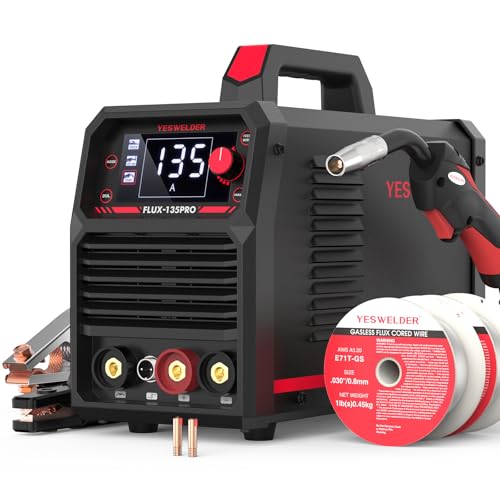


Product images: Amazon listings
Frequently asked questions
What should I look for in a multiprocess welder?
The processes you will use, the torch or gun shipped for each, the amperage on your input voltage and the duty cycle with its amperage. Miller also advises budgeting for gas, PPE and consumables.
Is a multiprocess welder good for beginners?
Yes, if you start with MIG or flux-core, which Miller calls the easiest process to learn, and want the option of stick and TIG later without a second machine.
How many amps do I need in a multiprocess welder?
Use Miller's rule of about 1 amp per 0.001 inch of steel: around 125 A for 1/8 inch, 250 A for 1/4 inch. Then check that amperage on the input voltage you actually have.
Is a multiprocess welder worth it?
It is when you will really use two or more processes: Miller notes they save buying several machines and suit shop work across stick, TIG, MIG and flux-core. If you only ever run wire, a dedicated MIG welder is simpler.
Sources
- Miller Electric — Buying Your First Welder: A Practical, Informative Guide for Do-It-Yourselfers (consulted Nov 2026)
- Miller Electric — Millermatic 211 PRO: specifications (consulted Nov 2026)
- Hobart Welding Products (spec sheet, dealer-hosted PDF) — Handler 140 specification sheet (consulted Nov 2026)
- Miller Electric — Duty Cycle: What It Is and Why It’s Important (consulted Nov 2026)
- Fronius — Ignis 150/180 TIG operating instructions (consulted Nov 2026)
- Miller Electric — Guide to TIG Welding Basics (consulted Nov 2026)
- Miller Electric — MIG Aluminum DIY: Selecting the Right Welder, Spool Gun and Filler Wire (consulted Nov 2026)
- Miller Electric — MIG Welding: Setting the Correct Parameters (consulted Nov 2026)