Welder duty cycle explained: percent and amperage
Understand what a duty-cycle percentage means, why its amperage basis matters and how to use our planner without treating it as a thermal guarantee.

A welder's duty cycle is the number of minutes out of 10 that it can weld at a stated amperage before it has to cool down: 30 % at 215 A means 3 minutes of arc and 7 minutes of rest at 215 A. The same machine has a higher duty cycle at lower amperage, so a percentage without its amperage tells you very little. Here is how to read the figure, compare two machines fairly and work out how much duty cycle you actually need.
Our rankings for this: best multiprocess welders and best flux core welders.
Affiliate disclosureAs an Amazon Associate we earn from qualifying purchases made through links on this page. Commissions never change our ratings.
What the percentage means
Duty cycle is always measured over a 10-minute period. Divide the percentage by 10 and you get the minutes of arc time. Miller Electric's example is its Millermatic 211 PRO: 30 % at 215 A on 240 V means three minutes of welding, then seven minutes of cooling. Fronius explains it the same way in its manuals, with 150 A at 60 %: six minutes of welding, four minutes of cooling, then the cycle starts again.
Fronius adds a detail most listings leave out: the ratings on the rating plate assume an ambient temperature of 40 °C (104 °F). In a hotter shop the duty cycle or the output has to come down.
| Duty cycle | Arc time | Cooling time |
|---|---|---|
| 20 % | 2 min | 8 min |
| 30 % | 3 min | 7 min |
| 40 % | 4 min | 6 min |
| 60 % | 6 min | 4 min |
| 100 % | 10 min | none |
Why the amperage decides everything
Higher current means more heat inside the machine, so the duty cycle drops as amperage rises. Miller's own figures show how big the swing is: the Multimatic 220 AC/DC is rated at 60 % when MIG welding at 105 A, but only 20 % at 200 A. The Millermatic 211 PRO's spec sheet lists 60 % at 110 A on 120 V and 60 % at 160 A on 240 V, while the same machine is rated 30 % at 215 A. Same box, four different numbers, all correct.
That is why comparing two listings is only fair at the same amperage and the same input voltage. A listing that says "60 % duty cycle" with no amperage could mean 60 % at the top of its range or at a low setting; you cannot tell. Look for the full rating ("40 % at 200 A") in the listing or the manual, which is where Miller says the duty cycle chart lives.
What a 100 % duty cycle welder means
A 100 % rating means the machine can weld continuously at that amperage without a cooling break. Every machine has one, just at a lower current. Hypertherm's Powermax45 XP plasma cutter is a clear example: 50 % at 45 A, 60 % at 41 A and 100 % at 32 A, all at 40 °C. Fronius gives the practical rule: if you need to weld without stopping, find the 100 % value in the technical data and stay at or below that current.
So when someone asks for a "100 percent duty cycle welder", the real question is: 100 % at which amperage? For long seams on thick plate that number matters. For a garage it usually does not.
How much duty cycle do you need?
Miller's advice is to pick a welder for the work you do most, "not the top speed". In a home shop you weld short beads at moderate current and stop often to reposition, check and grind, so a modest rating covers most jobs. Production welders who run long seams at high current usually want around 60 %.
- Tack welds, brackets, repairs: 20-30 % at your working amperage is rarely a limit.
- Long seams on 1/4 in steel: at about 250 A (Miller's 1 A per 0.001 in rule) look for a machine whose duty cycle at that current still gives you a few minutes of arc.
- Hot garage in summer: remember the 40 °C basis; above that the real duty cycle is lower.
- Cutting with plasma: long cuts behave like long seams, so read the cutter's rating at the amperage you cut at.
Our duty cycle planner turns a listed rating into minutes of arc per 10-minute cycle, using exactly this arithmetic.
And if you go past it? A machine with thermal overload protection shuts its output off when the internals get too hot, and you wait until it cools. Miller warns that running past the duty cycle again and again shortens the life of internal parts, and that breaking a weld into many short runs can heat and cool the metal often enough to cause warping. Keeping the vents clear and the machine clean, Miller adds, helps it reach its rated duty cycle.
Duty cycle in our rated picks
The figures below are those stated in the exact listings. They show what a complete rating looks like and what an incomplete one looks like.
- Weldpro 200A AC/DC Pulse TIG Welder (9.4/10) states 40 % at 200 A: four minutes of arc per ten at full output, a complete rating.
- Lincoln Electric Power MIG 211i (9.2/10) states 30 % at 175 A, on a machine that goes up to 211 A according to its listing.
- ARCCAPTAIN MIG205MP with Plasma Cutter (8.1/10) states 60 % but no amperage for it, so the figure cannot be compared until you find the rating in its manual.
Compare more machines in our multiprocess welder ranking and the flux core MIG ranking.
Our rated picks
The three best-rated models of our best multiprocess welders ranking, from the buyer review record and the listed specs.
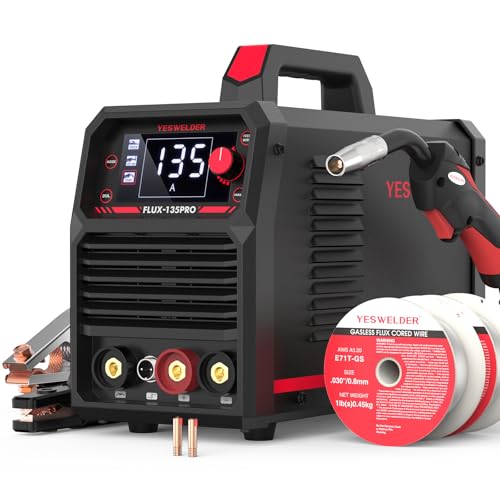


Product images: Amazon listings
Frequently asked questions
What is a good duty cycle for a welder?
For home and hobby use, 20-30 % at the amperage you actually weld at is usually enough, because you stop often. Miller says production welders running long seams typically use machines with about 60 %.
What does 60 % duty cycle mean?
The machine can weld 6 minutes out of every 10 at the stated amperage, then needs 4 minutes to cool. Fronius uses exactly this example: 150 A at 60 % is six minutes of welding and four of cooling.
What is a 100 % duty cycle welder?
One that can weld without a break at a stated amperage. Every welder has a 100 % rating at some lower current; Hypertherm lists 100 % at 32 A for a cutter rated 50 % at 45 A.
What happens if you exceed the duty cycle?
Usually the thermal overload switches the output off until the machine cools. Miller warns that pushing past the duty cycle repeatedly wears the internal components faster.
Sources
- Miller Electric — Duty Cycle: What It Is and Why It’s Important (consulted Nov 2026)
- Miller Electric — Buying Your First Welder: A Practical, Informative Guide for Do-It-Yourselfers (consulted Nov 2026)
- Miller Electric — Millermatic 211 PRO: specifications (consulted Nov 2026)
- Fronius — Ignis 150/180 TIG operating instructions (consulted Nov 2026)
- Hypertherm — Powermax45 XP plasma cutter: specifications (consulted Nov 2026)